

We talk a lot about boundaries in caregiving. Set limits around your time. Be clear about what you can and cannot do. Don’t answer every call. Don’t automatically become the person responsible for every appointment, every crisis, every decision, and every task. All of that matters, especially for adult children who are trying to support an aging parent while also managing careers, children, relationships, health, and their own lives.
But there is a part of boundary-setting that I don’t think we talk about nearly enough: what happens after you actually hold one?
Setting a boundary is one decision. Living with it is something else entirely. A boundary does not erase the relationship. It doesn’t erase the history, the love, the loyalty, the grief, the hope, the disappointment, or the part of you that still wishes things could be different.
This becomes particularly complicated when caregiving is layered over a strained or difficult parent-child relationship. You may have decided that you cannot be the person who manages everything. You may have limited contact. You may have decided that certain conversations are no longer healthy for you. You may even have stepped away completely. That can still be the right decision, and it can still hurt.
That is the part people sometimes mistake.
They feel grief and assume the boundary must have been wrong. They miss their parent and wonder whether they should reopen the door. They feel guilty when their parent gets older, becomes ill, or needs more help. Suddenly, the mind starts renegotiating a decision that may have taken years to make.
Maybe I should do more. Maybe I was too hard. Maybe things are different now. Maybe I’ll regret this.
But grief is not always an instruction. Missing someone does not automatically mean you need to change the boundary. Feeling sad does not mean the decision was wrong. Sometimes it simply means the relationship mattered.
I’ve been thinking about this a lot in my own life lately. We recently put in a pool, and for weeks there were excavators, concrete trucks, equipment, landscaping, and all of the chaos that comes with a major backyard project. Over and over again, I found myself thinking the same thing: my dad would love this.
He would have loved watching the machines. He would have asked questions about how everything worked. He would have had opinions about the equipment, the construction, and probably half a dozen suggestions. And I wanted to show him.
That longing has created an unexpected layer of grief because I can miss him. I can wish he were standing in my backyard. I can know exactly how much he would enjoy seeing it. And I can still understand why the distance exists.
Both things can be true.
That is one of the harder parts of self-trust. Self-trust is not reaching a decision and never feeling anything about it again. It is being able to feel sadness, longing, guilt, or uncertainty without immediately abandoning what you know about the situation.
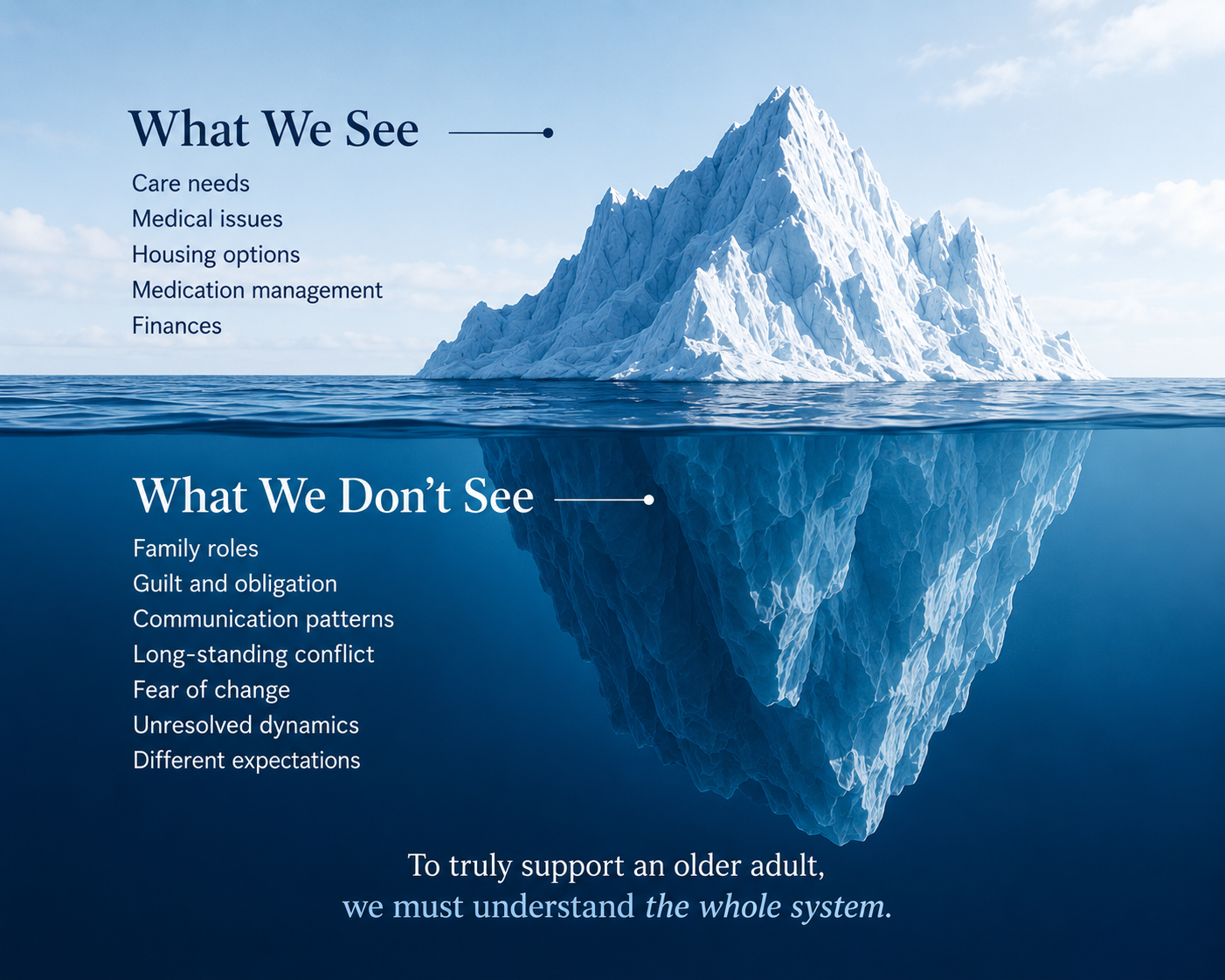
In caregiving, that distinction matters because aging has a way of turning the volume up on family dynamics. A hospital admission happens. A parent needs more support. Someone falls. A diagnosis changes everything. Suddenly, old roles can snap back into place very quickly.
The capable daughter becomes the organizer. The peacekeeper starts mediating. The fixer starts fixing. The person who has spent years building boundaries begins questioning whether she is allowed to keep them.
That is why boundaries around aging parents cannot only be about what you will and will not do. They also have to include trust in your own judgment.
You can care about someone and still recognize your limits. You can feel grief without treating it as a directive. You can reconsider a decision if circumstances genuinely change, but you do not have to reconsider it simply because it hurts.
And sometimes the most grounded place to stand is in two truths at once:
I wish this were different.
And I still know why I made the decision I did.
That space between those two truths is often where self-trust is built.
I dive deeper into the story about my dad, the pool, and the grief that can come with holding a boundary in next week’s newsletter.
If you want the more personal side of these conversations, you can sign up here