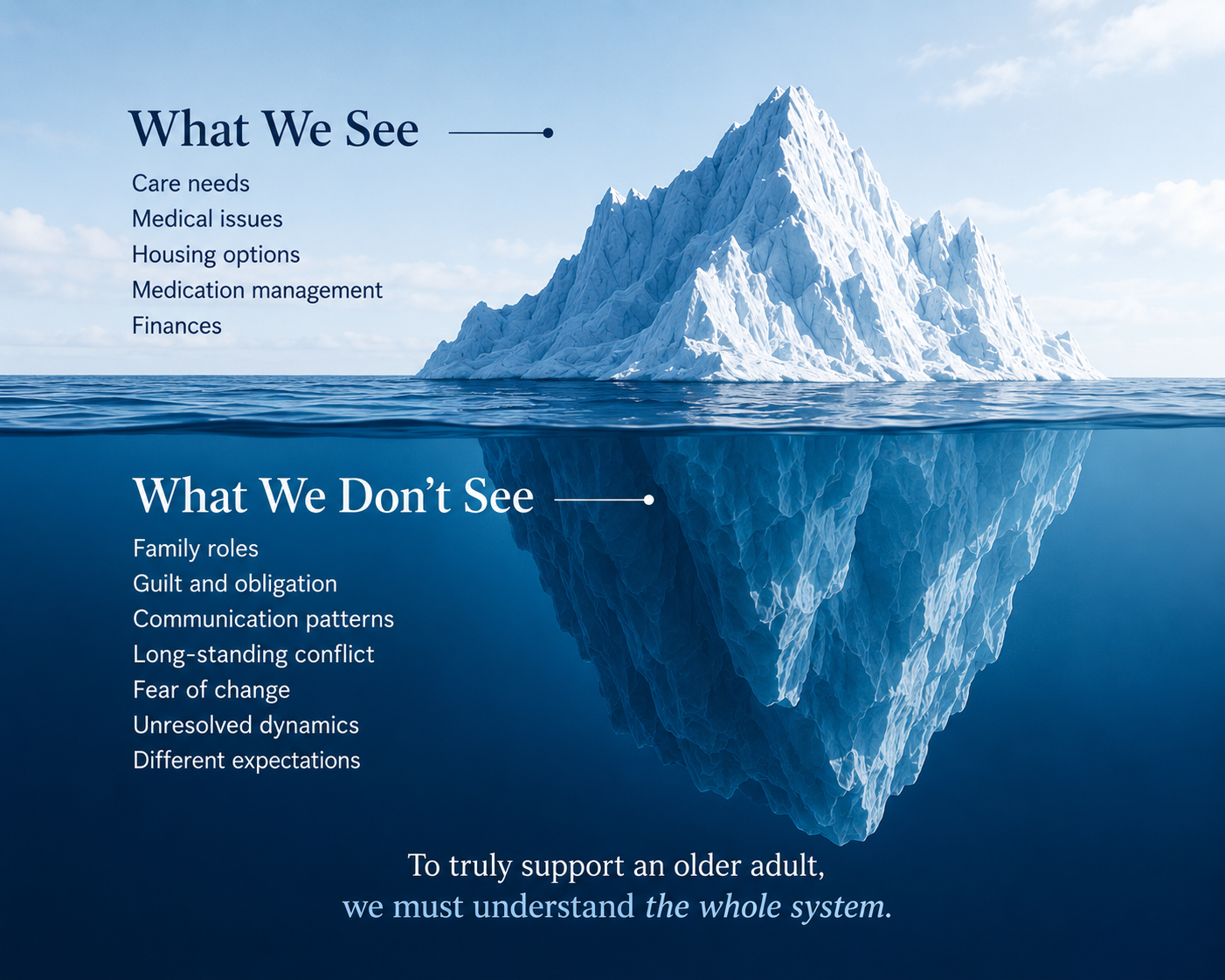


When professionals work with an older adult, it can be really easy to focus on the issue sitting directly in front of them.
The financial advisor is talking about a beneficiary change. The lawyer is reviewing a Power of Attorney. The social worker is trying to figure out discharge planning. The retirement professional is talking about whether it is time to move.
On paper, those all look like fairly specific conversations.
But families do not experience them that way.
Because the family does not stay outside the meeting room.
It comes in with them.
So does the history.
The sibling who has always taken charge is probably still taking charge. The person who has always tried to keep the peace is probably still trying to keep everyone happy. The family member who lives closest may have quietly become responsible for almost everything. The person who has always controlled the finances may be having a very hard time letting anyone else see what is happening.
Sometimes an estranged child suddenly reappears. Sometimes the child everyone assumes will step in decides they cannot. Sometimes one sibling looks deeply involved, and another looks completely absent.
None of that automatically tells you what is happening.
But it is information.
And when someone starts experiencing changes in health, cognition, independence, or decision-making, all of those old family dynamics tend to become much more visible.
That is where things can get complicated.
A professional might see a daughter answering every question for her father and think she is controlling.
Maybe she is.
Or maybe she has been managing his appointments for three years because he cannot retain new information.
A son who never shows up might look uninvolved.
Maybe he is.
Or maybe there is a long family history that makes stepping into a caregiving role unrealistic or unsafe.
Two siblings might be fighting over whether their mother should move into retirement living, and from the outside it looks like they are arguing about housing.
They may not really be arguing about housing at all.
They may be arguing about who has always carried the responsibility, who has avoided it, who controls the money, who gets listened to, and who is expected to fix everything.
The current problem is just where all of that history is landing.
That is one of the things I think we miss when we talk about aging and caregiving.
Aging does not reset the family.
People do not suddenly become completely different versions of themselves because someone turns 80 or needs help.
The fixer still fixes. The avoider still avoids. The peacekeeper still tries to keep everyone calm. The responsible one tends to get handed more responsibility. The person who has always had the power may struggle when that starts to shift.
Sometimes those roles work just fine.
Sometimes they create chaos.
But they are almost always still there.
And then cognition adds another layer.
Cognitive change is not always obvious. Someone can still be social, funny, conversational, and able to answer familiar questions while struggling with judgment, executive functioning, sequencing, or retaining new information.
That makes these conversations even harder for professionals.
A client may say they understand.
They may agree with a recommendation.
They may even repeat part of the conversation back to you.
That does not always mean they fully understand the decision or the consequences of it.
At the same time, the family may all have completely different opinions about what is happening.
One child may think their parent is perfectly capable. Another may think they should not be making decisions alone. A spouse may minimize what is changing. Someone else may be so worried that they overstate it.
And the professional is left trying to figure out what they are actually looking at.
That does not mean professionals need to become family therapists.
They do not need to diagnose the family, decide who is right, or step outside their professional role.
But they do need context.
Who is answering the questions?
Who is not speaking?
Has this person’s behaviour changed?
Is the client actually making the decision?
Do they seem to understand what is being discussed?
Has this family member always been involved, or is this new?
Are people disagreeing about the actual decision, or are old family issues showing up through the decision?
Sometimes the most useful thing a professional can do is slow down long enough to notice what is happening around the issue in front of them.
Because the financial decision may also be a caregiving decision.
The housing decision may also be a family-role decision.
The legal conversation may also be happening in the middle of cognitive change.
And the conflict in the room may have started decades before the current crisis.
Professionals do not have to solve the family.
But the family is part of the context.
And if you work with older adults, it is in the room whether anyone talks about it or not.