
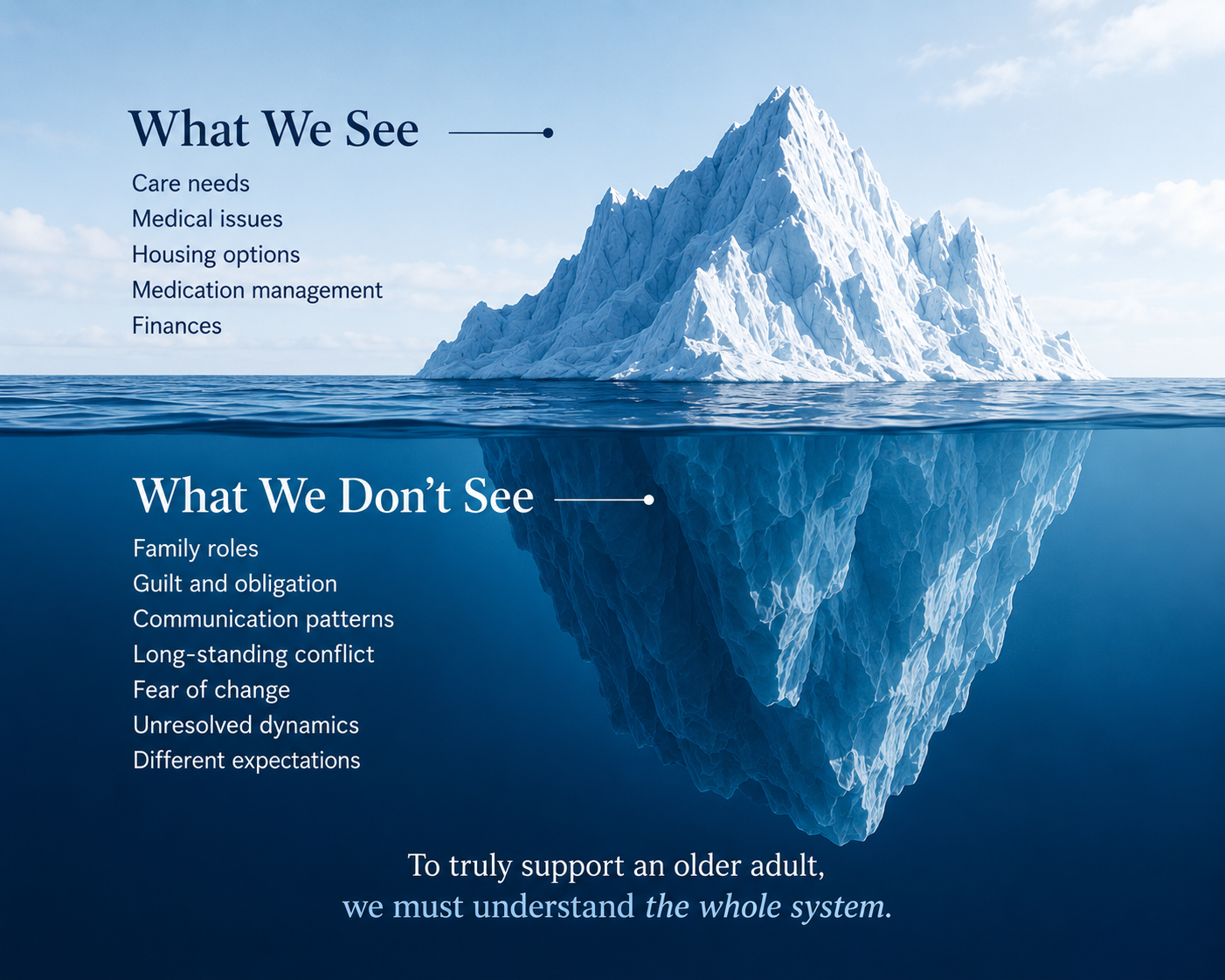

When an older adult needs support, most professionals know what to assess. Can they manage their medications? Is the home safe? What financial resources are available? What level of care is required?
These are all important questions. However, after more than twenty years working with families navigating aging, I've noticed a blind spot that often creates more barriers than any diagnosis, mobility challenge, or financial concern.
We rarely assess the family system.
Instead, we tend to assume that the family sitting in front of us is functioning in a relatively predictable way. We assume that the adult child attending every appointment has a close relationship with their parent. We assume the sibling speaking the loudest is the decision-maker. We assume resistance to care is rooted in fear of change. We assume families who appear calm and cooperative are healthy.
Often, none of those assumptions are true.
Some families are like glass houses. From the outside, everything appears intact. There are holiday photos, polite conversations, and adult children showing up for appointments. There are no obvious signs of conflict. Yet inside the family system, there may be decades of unresolved dynamics influencing every decision being made.
Favoritism, parentification, control, fear, emotional dependency, long-standing conflict, and rigid family roles often existed long before aging entered the picture. A retirement home recommendation will not resolve those dynamics. Neither will a home care referral or a hospital discharge plan. Yet those same dynamics frequently determine whether any plan succeeds.
I once worked with an older couple where the wife clearly required additional support. On paper, the solution appeared straightforward. The challenge wasn't finding the right support; it was understanding why she could not imagine functioning independently from her husband.
Simple tasks that many people take for granted felt impossible to her. The more professionals focused on the logistics, the more stuck the situation became. The barrier wasn't practical. It was relational. Until we understand the underlying dynamics, we can spend months trying to solve the wrong problem.
This is also why professionals are often surprised when families seem to disappear after a loved one moves into a retirement home or long-term care home. Staff are left wondering how someone could abandon a parent.
Sometimes those assumptions are accurate. Sometimes families have disengaged for reasons that deserve scrutiny. However, there are also situations where what we're witnessing is the final chapter of a relationship that has been strained, complicated, or harmful for decades.
The move itself did not create the distance. The distance already existed. The care system is simply seeing it for the first time.
Likewise, when families resist recommendations, delay decisions, or remain stuck despite clear evidence that change is needed, the issue is not always a lack of information. In my experience, information is rarely the problem.
Most families have access to more information than ever before. What they often lack is an understanding of the emotional and relational forces driving their decisions. Fear, guilt, obligation, loyalty, and family roles established decades ago continue to shape the choices being made today.
When those dynamics remain unaddressed, every conversation feels like pushing a boulder uphill. The professional provides more information. The family remains stuck. Frustration grows on both sides, and everyone wonders why progress isn't happening.
We often talk about meeting older adults where they are. I believe we should extend that same curiosity to families. Before assuming a family is difficult, disengaged, resistant, uninvolved, or unwilling to help, it is worth asking what story existed before we entered the picture.
As professionals, we are often seeing a single chapter of a relationship that has been unfolding for fifty or sixty years. We may be witnessing the effects of decades of family roles, unresolved conflict, emotional wounds, or patterns that were established long before a health crisis occurred. Without understanding that context, it is easy to misinterpret what is happening in front of us.
The missing piece is often not another resource. It's a better understanding of the system itself.
Family dynamics do not disappear when someone ages. If anything, they become more visible. The most effective professionals I've met understand this instinctively. They listen for the history underneath the problem. They pay attention to family roles. They notice who speaks, who stays silent, who carries the burden, and who avoids it.
They understand that the family sitting in front of them today is often operating according to patterns established decades earlier.
When we begin viewing aging through a family systems lens, many situations that once seemed irrational suddenly make sense. And when things make sense, meaningful solutions become much easier to find.
The older adult is only one part of the picture. To truly understand the challenges families face, we must also understand the system surrounding them.
---------------
Understanding family dynamics doesn't mean becoming a therapist, nor is it about diagnosing families.
It's about recognizing that the older adult is only one part of the picture.
When professionals can identify the relational factors influencing a situation, resistance often makes more sense, conflict becomes easier to navigate, and care plans become more realistic.
If you're interested in exploring this lens further, I've created a free Family Dynamics Observation Guide for Aging Families to help professionals recognize common patterns, ask better questions, and approach challenging family situations with greater context and curiosity.
Because when we understand the system, we can often better understand the decisions being made within it.