

There’s a moment most adult children recognize.
You know you should bring something up.
Their safety.
Their memory.
Their living situation.
Their driving.
Their finances.
Their increasing forgetfulness.
And yet… you don’t. You wait.
You circle the topic in your mind for weeks or months. You rehearse the conversation while driving. You think about saying something during holidays, appointments, or after “the next incident.” You tell yourself you’ll bring it up soon—when things settle down, when they’re in a better mood, when you have more information, when you feel more emotionally prepared.
But the conversation never fully arrives. And contrary to popular belief, this usually isn’t simple avoidance.
It’s layered. Emotional. Complex. Often strategic.
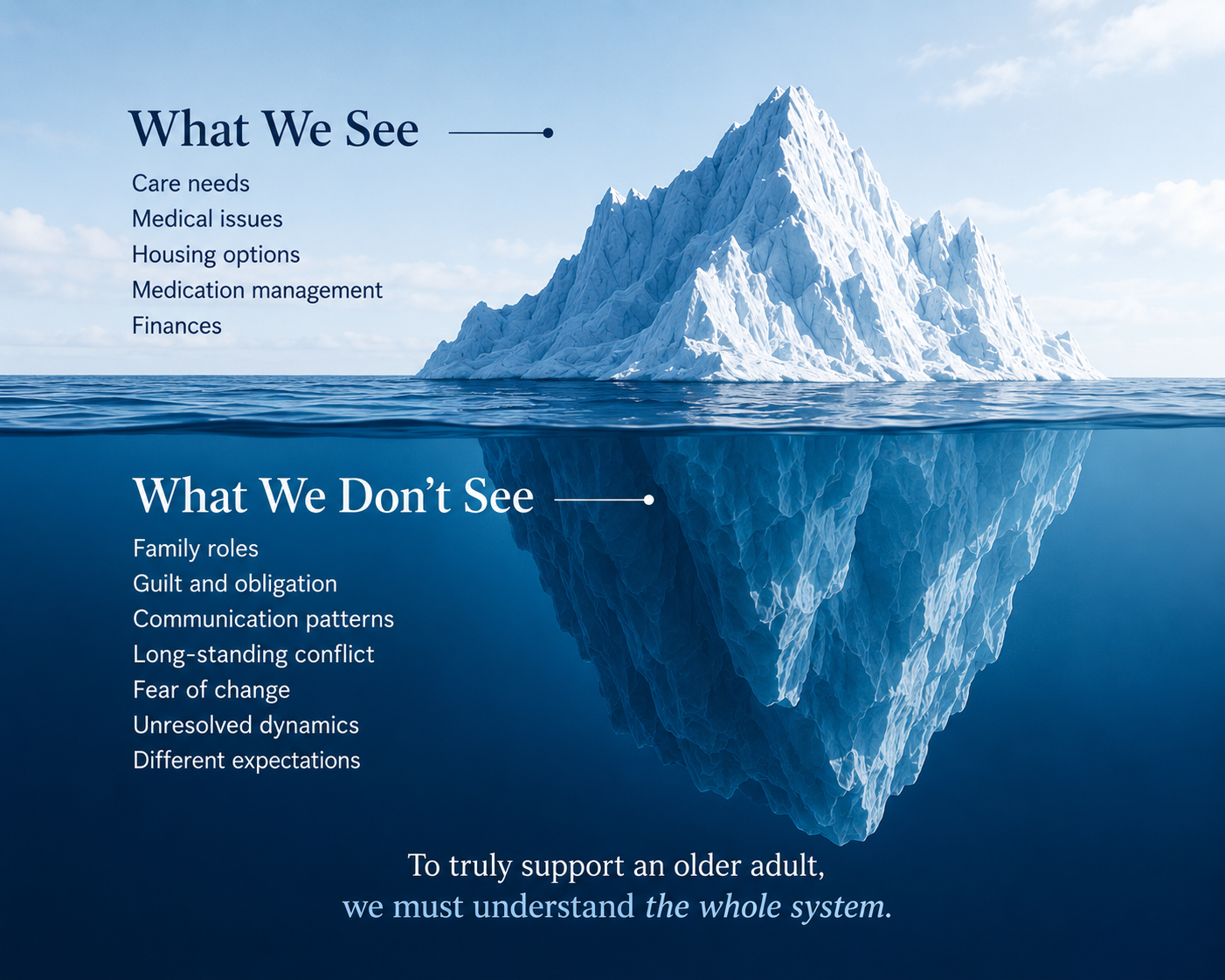
Because caregiving conversations are rarely just conversations. They’re emotional landmines tied to identity, family dynamics, fear, aging, loss of independence, guilt, and power shifts within the family.
1. The Conversation Feels Heavy — and the Timing Never Feels Right
Caregiving conversations aren’t casual conversations.
You’re not asking:
“What should we order for dinner?”
You’re asking:
- Should you still be driving?
- Is your home still safe?
- Are you remembering your medication properly?
- What happens if there’s an emergency?
- Do we need to talk about support… or moving?
These are identity-level conversations.
To an aging parent, these discussions can feel like:
- loss of independence,
- loss of control,
- loss of dignity,
- or proof that aging is becoming harder to ignore.
And adult children feel that weight too. So what happens?
Most people wait for:
- a calmer mood,
- a better day,
- a successful doctor’s appointment,
- a family gathering,
- or the mythical “perfect moment.”
But the truth is:
There is rarely a perfect entry point into a difficult caregiving conversation.
Most families don’t suddenly wake up emotionally prepared to discuss aging, decline, safety, or future care planning. In fact, many families have spent years avoiding difficult conversations long before caregiving ever entered the picture.
So the delay often becomes less about readiness… and more about emotional protection.
Because once the conversation starts, it changes something.
Even if nothing changes immediately, everyone suddenly becomes aware that the topic exists.
And that awareness can feel incredibly uncomfortable.
2. You Don’t Realize How Close You Might Be to a Crisis
One of the biggest misconceptions caregivers have is believing they have more time than they actually do.
Not because they’re irresponsible.
Not because they don’t care.
But because most people don’t truly understand what a caregiving crisis looks like until they’re already inside one.
A crisis is not always dramatic.
It doesn’t always arrive with flashing lights and obvious warning signs.
More often, it looks like:
- a fall that changes mobility overnight,
- a hospital admission that suddenly leads to “they’re not safe to return home,”
- wandering,
- confusion around medication,
- a stove left on,
- unpaid bills piling up,
- or a cognitive decline that quietly removes decision-making capacity before anyone fully realizes it.
And an impending crisis?
That’s even quieter.
It often looks like:
- increasing forgetfulness being brushed off as “normal aging,”
- repeated near misses,
- small safety issues stacking up,
- growing resistance paired with declining capacity,
- caregiver burnout building in the background,
- or a family system that is already stretched thin emotionally.
Many caregivers normalize these signs because they’re adapting in real time. Humans are incredibly good at adapting slowly to worsening situations. What felt shocking six months ago starts to feel “manageable” because you’ve gradually adjusted to it. And because decline is often gradual before it becomes sudden, families frequently mistake temporary stability for actual stability.
So they say:
“We still have time.”
But often, what they really have is a narrowing window before decisions start getting made reactively instead of proactively. And reactive decisions tend to happen under pressure, exhaustion, fear, or crisis conditions.
3. You’ve Tried Before — and It Went Nowhere
This is where many caregivers get emotionally stuck.
Because they have tried.
Maybe multiple times.
Maybe gently.
Maybe directly.
Maybe emotionally.
Maybe strategically.
And the conversations went nowhere.
Maybe their parent:
- dismissed the concern,
- minimized the issue,
- became defensive,
- changed the subject,
- accused you of overreacting,
- or agreed temporarily… only for nothing to actually change afterward.
So eventually, something shifts internally. You stop avoiding the conversation itself. You start avoiding the emotional loop.
Because it is exhausting to:
- emotionally prepare yourself,
- gather the courage to bring it up,
- manage the tension afterward,
- and then land right back where you started.
Over time, this creates a quiet hopelessness that many caregivers don’t talk about openly.
You start thinking:
“What’s the point of bringing it up again?”
And that question is important—because sometimes repeated circular conversations are not communication failures.
They’re pattern recognition.
Some family systems genuinely do not move through logic, planning, or early intervention. Some people only change when circumstances force change.
And understanding that distinction matters. Because otherwise caregivers often stay trapped believing:
“If I could just explain it better, maybe this time would be different.”
4. You Don’t Actually Have Access to the Conversation
This is the piece that gets missed the most in caregiving discussions.
Not all caregivers have equal access.
Some adult children can sit at the kitchen table and have difficult conversations, even if they’re uncomfortable.
Others are navigating:
- emotionally volatile relationships,
- controlling family dynamics,
- long-standing dysfunction,
- emotional cutoffs,
- manipulation,
- sibling conflict,
- narcissistic dynamics,
- or full estrangement.
In these situations, the issue is not:
“Why aren’t you having the conversation?”
The real question becomes:
“Do you actually have access to have one?”
Because caregiving advice often assumes:
- healthy communication,
- emotional reciprocity,
- mutual respect,
- and willingness to plan.
But many adult children are operating in systems where those things have never existed.
And when people don’t understand this reality, caregivers often internalize shame for not “doing more,” even when the door was never truly open to begin with.
That distinction matters deeply. Because you cannot force emotional access where none exists.
You cannot build collaboration by yourself.
And you cannot communicate your way through every dynamic.
A More Honest Way to Look at Caregiving Conversations
Instead of asking:
“Why am I avoiding this?”
A more useful question is:
“What level of access do I actually have here?”
1. Full Care Access
You can:
- initiate conversations,
- be heard (even if not always agreed with),
- collaborate over time,
- and gradually influence decisions.
The challenge here is usually:
- education,
- planning,
- timing,
- and recognizing decline early enough to act proactively.
2. Limited Care Access
You can:
- have conversations,
- but they stall,
- loop,
- derail,
- or become emotionally charged.
You face:
- resistance,
- avoidance,
- deflection,
- or repeated cycles that never fully move forward.
The challenge here is often:
- boundary setting,
- pattern recognition,
- understanding capacity,
- and recognizing when crisis may become the thing that forces change.
3. No Care Access
You:
- cannot have meaningful conversations,
- are shut out,
- dismissed,
- emotionally cut off,
- or estranged.
You have little to no influence over decisions. And this changes the caregiving conversation entirely. Because the challenge here is no longer communication.
It becomes:
- grief,
- acceptance,
- clarity,
- emotional protection,
- and redefining your role.
The Shift Most Caregivers Actually Need
Most caregivers don’t need more scripts.
They need clearer understanding of:
- what dynamic they’re actually operating within,
- what level of access they truly have,
- and what risks are developing underneath the surface.
Because:
- you cannot force readiness,
- you cannot logic someone into accepting decline,
- you cannot create access where none exists,
- and you cannot properly plan if you don’t recognize the signs of instability early enough.
What does help is:
- understanding the difference between stability and decline,
- recognizing when you are approaching a crisis window,
- identifying repeated relational patterns,
- and making decisions based on reality instead of hope.
Because avoiding the conversation is not always avoidance.
Sometimes it’s:
- exhaustion,
- grief,
- burnout,
- emotional self-protection,
- pattern recognition,
- or a quiet understanding that the relationship itself limits what’s possible.
But sometimes…
It’s also a misunderstanding of how quickly situations can change once decline accelerates.
And when caregivers can see both clearly—the emotional dynamic and the practical risk—they often stop asking:
“How do I get them to listen?”
And start asking:
“What’s actually mine to carry here… before the decision gets made for me?”
If you’re finding yourself stuck between guilt, responsibility, exhaustion, and uncertainty, sometimes the first step isn’t having another conversation, it’s getting clearer on the dynamic you’re actually operating within.
That’s exactly why I created the Caregiving Role Audit — a free tool designed to help you better understand your level of care access, the patterns showing up, and what role may realistically be yours to carry.
You can access the free audit here: Caregiving Role Audit