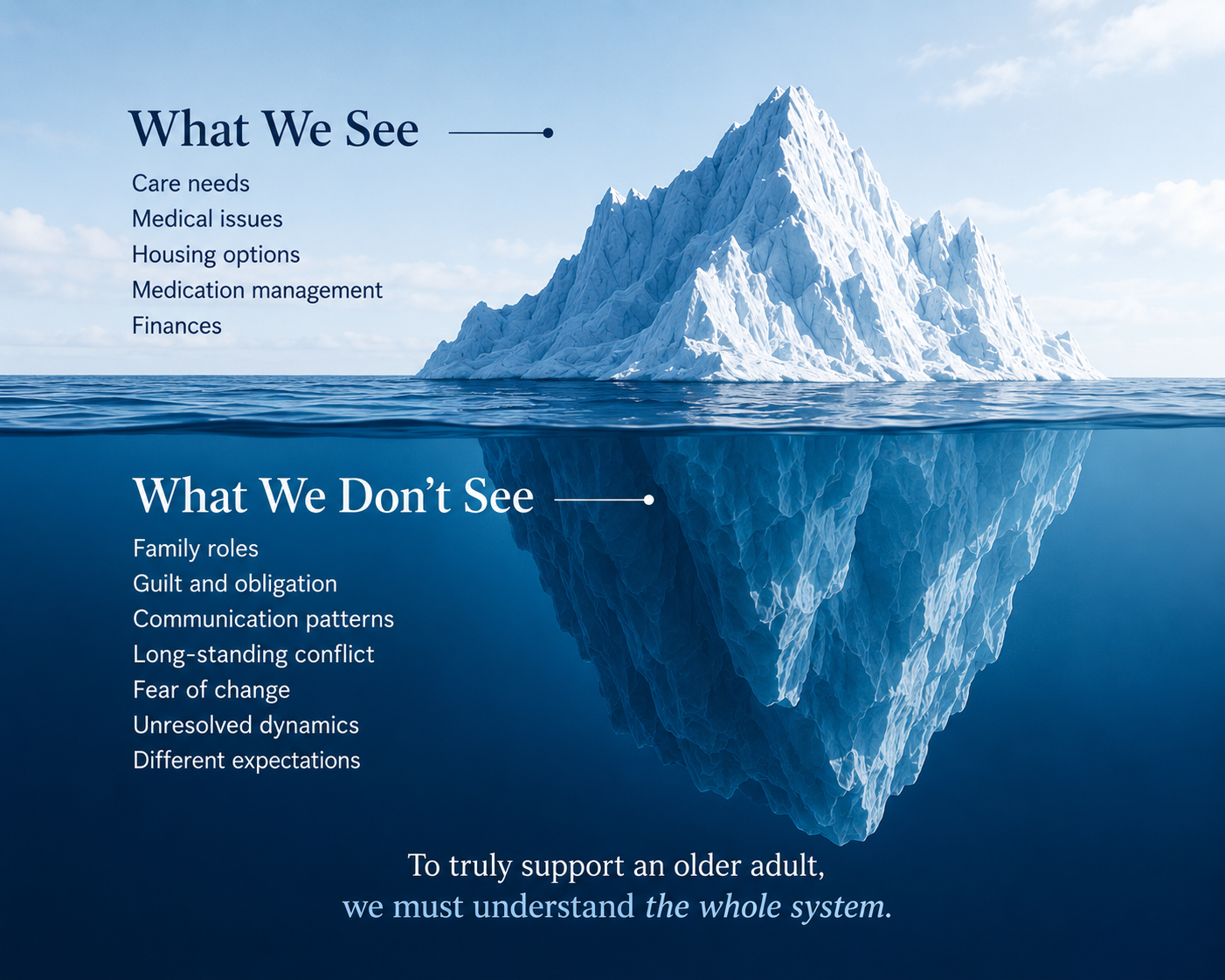


What I see inside family meetings after a hospital crisis.
A parent goes into the hospital living independently and comes out unable to return home.
It happens fast. One event, a fall, delirium, stroke, sudden diagnosis, and the family moves from occasional support to full decision-making responsibility in a matter of days.
There was no gradual planning period. No long conversations about the future. Just a discharge date and a list of decisions:
Where will they live? Who handles finances? Can we access paperwork? Do we sell the house?
And suddenly, three adult children are standing in a retirement residence trying to choose a future none of them expected to be choosing yet.
You can usually feel the alliances before anyone says a word.
One speaks confidently about costs and timelines.
Another asks rapid-fire questions, trying to understand everything at once.
And one stands slightly behind — quiet, observant, saying very little.
If you didn’t know what you were seeing, you might assume the quiet one agrees.
They usually don’t.
Silence Is Not Agreement
In care tours, families often measure engagement by volume. The person talking the most appears most invested.
But silence often means something else: the person is not yet convinced the situation has been fully understood.
Some people process by talking. Some by organizing. Some by withholding judgment until they trust the information.
The quiet sibling is frequently the one mentally testing permanence, not resisting care, but resisting irreversible decisions based on partial understanding.
Unfortunately, urgency does not tolerate hesitation well.
Two people start moving forward.
One person slows the pace.
And the slowdown begins to look like opposition.
The Roles Families Fall Into
After a sudden health crisis, siblings unconsciously organize around anxiety.
- The financially-focused child seeks certainty: we need a workable plan
- The information-seeking child seeks clarity: we need to understand everything
- The quiet child seeks consequence awareness: we need to be sure this is necessary
Now the family appears to be arguing about a residence.
They aren’t.
They are reacting to three different fears:
- financial damage
- making the wrong choice
- causing permanent loss
Because the cautious person speaks last — or not at all — they become the outlier in the room.
Not wrong. Just outpaced.
My Role in the Room
As an Eldercare planner, this is one of the moments I watch most carefully.
My job isn’t just presenting housing options. It’s understanding family dynamics under pressure. Families don’t communicate evenly in crisis, and the quiet person is often processing just as intensely as the others, just internally.
So I slow the conversation down. I ask questions that bring them in. I make sure their concerns are heard before decisions harden. Not because they’re “right,” but because decisions made without the whole family’s understanding rarely hold together afterward.
Where Decisions Start to Go Sideways
After hospitalization, families often believe the situation is obvious and urgent.
I frequently hear:
“The hospital said she can’t go home.”
What that usually means is:
She cannot safely go home today without support.
Those are very different timelines.
Without clarifying that difference, one sibling plans a permanent move, another pushes back on speed, and the quiet one stops trusting the process entirely.
From that point forward, every practical decision becomes emotional: the residence, the timing, even the tone of conversations.
The House Complicates Everything
Then the discussion shifts to the home.
Who can access documents?
Was anything organized?
Should we list it immediately?
The temperature in the room changes.
Selling a home feels final. Moving feels final.
When final decisions happen before shared understanding exists, families stop debating logistics and start protecting positions.
They are no longer deciding what to do. They are defending what they believe is happening.
The Missing Step
Families often try to reach an agreement on the solution before agreeing on the reality.
But most conflict disappears once everyone answers the same questions:
What has permanently changed?
What might improve?
What risk exists now versus next month?
What would our parent consider an acceptable quality of life?
Without this step, siblings solve different problems:
One solves finances. One solves information gaps. One solves long-term consequences.
No one is solving the same decision.
The Value of the Hesitant Voice
In many families, the quiet or cautious sibling becomes labeled as difficult.
Yet they often serve an important function; they slow the decision just enough to prevent regret.
Not forever.
Just until the family understands whether they are making a temporary adjustment or a permanent life change.
Families who skip that pause often argue afterward about whether the move was necessary.
Families who allow it usually move forward together, even if the decision is hard.
The Goal Isn’t Agreement
In a crisis, emotional agreement is unrealistic. What families need is alignment, a shared understanding of the situation before choosing a path.
Once everyone is deciding the same question: voices soften, questions become productive, and the quiet person starts participating.
Because they finally trust what is being decided.
A sudden decline forces adult children into decision-making roles overnight. Everyone is afraid of causing harm.
So some push forward, some push harder, and some step back.
But that cautious voice is often protecting the family from the only thing that cannot be undone, a decision made before the situation was truly understood.
Good Eldercare decisions are neither fast nor slow.
They are shared.